Making your own glazes
Basic properties of ceramic glazes
Many probably think that the most important aspect of a glaze is how it looks when finished. Its color and whether it is matte or glossy.
But also the temperature at which it melts. In other words, a property it has during firing.
If you start brushing a dipping glaze and a brushing glaze, you quickly notice that there are properties important before firing as well. Not all glazes are suitable for brushing.
Here I will go through some of the basic properties that glazes have. But not all. Because there are truly many factors that can be changed.
I will also not go into detail about which raw materials and substances affect what, but provide basic examples.
The aim is to give an overview of the possibilities and a fundamental insight into how it is done.
I will categorize the properties according to when they are important. Here is a list of that. It may seem like many points, but most are quite easy to approach.
The individual points are described further on the rest of the page. At least those I have managed to write about (in bold). And there will also be pictures.
- Before firing
- Storage (and settling)
- Application (penselglasur)
- Water content. Thicknes of glaze
- Handleness
- peeling
- Under the firing
- Temperature. melting point
- Temperature. interval
- Thicknes of glaze
- expansion (cracking, peeling)
- The finished glaze
- color
- Transparens
- Matte, blank
Before firing
Storage, settling, stirring, brushing, handling.
Clay does a lot of good for a glaze’s properties before firing. But there are also disadvantages.
The two properties settling and brushing are connected. A brush glaze does not settle easily, and a glaze that settles heavily will usually also be difficult to brush. The solutions are therefore to some extent the same.
Settling of glaze
There is a big difference between glazes that settle hard and those that are easy to stir up. This is because the different raw materials have varying tendencies to settle. Additionally, there are substances that can be added to prevent this or at least make it easier to stir up again.
To take the raw materials first.
Clay reduces settling and is easier to stir. The raw glaze will resemble more a slip (liquid clay) than a finished glaze.
So by replacing some kaolin with, for example, ball clay, you can improve it. But it also changes other things, so make a test first.
Gerstley Borate (GB) also helps against settling by causing the glaze to gel. Something that disappears when it’s stirred. It is a mineral that is not among the basic purchases I have mentioned here. It contains a fair amount of boron.
On glazy.com you can see that bentonite has been added to many glazes. It is an enormously fine plastic clay, often added at 2% to prevent hard settling. It should be added to the dry glaze, otherwise it will clump.
Application, brush-on glazes
things in the glaze that make it easy to brush
Clay and gerstley borate create glazes that do not settle as much and also make glazes easier to brush. For the same reasons that they reduce settling.
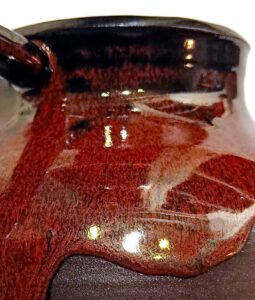
But there can also be something in the glaze that makes it difficult to brush on.
My experience is that glazes with a high content of iron oxide become very heavy to brush and tend to clump on the piece. And some glazes can contain a surprisingly large amount of iron.
For example, in the so-called beautiful red Kaki glazes like the one on the left.
Addition to the glaze to create a brush-on glaze
There are many tips on what to add to make a glaze suitable for brushing. I will only mention one thing. It is cheap, easy, and works really well.
It is the addition of CMC wallpaper paste. It is mixed with water, which you can keep in a bottle, and then add to your glazes. You can either add it to a whole bucket of glaze or add a few drops to a bowl with some glaze.
Handling the dry glaze
Once the glaze is applied, they also behave quite differently.
Nugle are impossible to rub the holes out on. Others are very sensitive to touch, etc.
Here, the clay also does a lot of good. A lot of clay gives a layer that resembles a slip, making it easy to handle.
Glazes with high content of clay
But clay doesn’t have any bad qualities? Oh, yes
Partly, it is a very variable material when you buy it. You can’t expect the contents of one bag to be exactly the same as the next.
And it shrinks, meaning it can cause cracking in the glaze already while it is drying.
But on the other hand, it is easy to apply before the bisque firing as a slip. During the bisque firing, the first firing, it becomes water-resistant just like the clay itself. Then you can easily apply another glaze on top or beside it after the bisque firing.
Glazing on raw clay – without pre-firing
Glazes with a high clay content behave very much like a slip when applied. Therefore, they can also be easily applied to the raw bisque before firing.
This can save one firing, but probably does not save energy in the end, as you cannot load the kiln as fully.
More importantly, you can apply one glaze on top of another without the underlying glaze dissolving due to the new glaze. The first “slip-glaze” is already firmly fired and absorbs water like a bisque.